Leaders from government, finance, healthcare and the food sector gathered at the Waldhuus Hotel in Davos this January for Breaking Bad: When Food Targets Health – a World Economic Forum Accredited Event that set out to confront a simple, uncomfortable truth: the modern food system is delivering abundance, but it is also driving metabolic illness at scale.

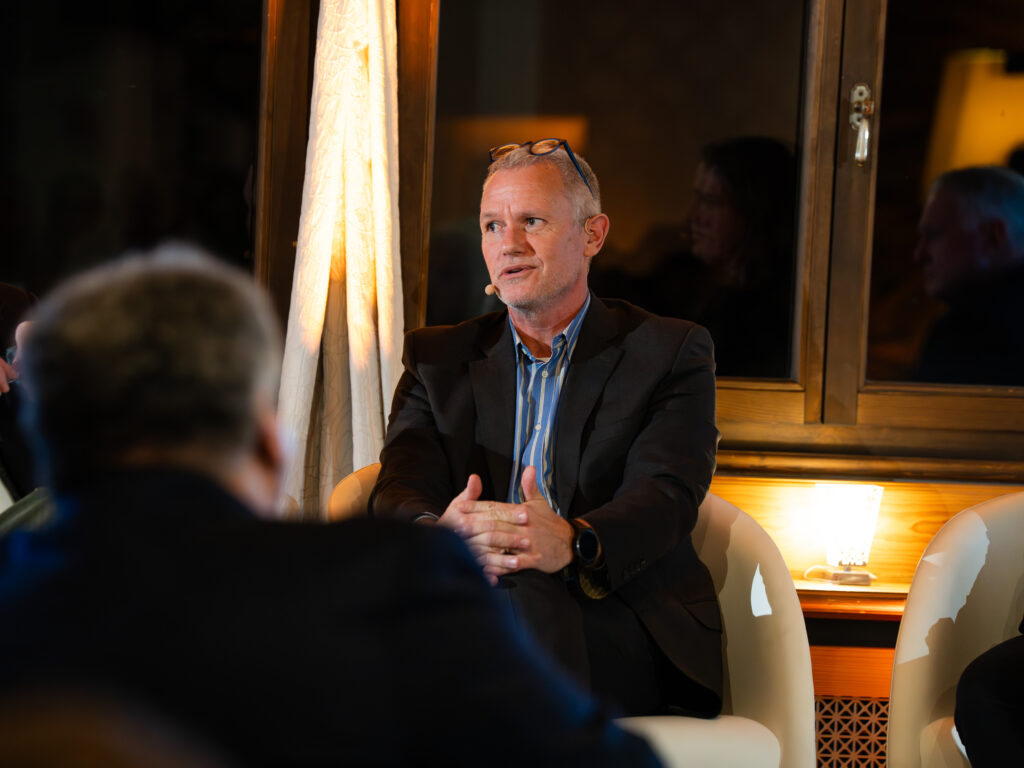
The Breaking Bad Panel (L-R): Geoff Cutmore (host), Paul Polman, Dr John Schoonbee, Dr Tracy Shafizadeh, Dr Robert Lustig
The conversation traced the problem upstream – towards incentives, ingredients, processing and the metrics that shape what ends up on shelves. The core argument was that many of today’s food choices are not really ‘choices’ at all: they are the predictable outcomes of an industrial system optimised for cheap calories, long shelf life and convenience, while health costs accrue downstream.
90% of health costs are because of non-communicable diseases. The underlying root cause is metabolic ill health
That mismatch is now colliding with hard numbers. The burden of non-communicable diseases is reshaping national health budgets, employer costs and long-term risk models. As Swiss Re’s Global Chief Medical Officer, Dr John Schoonbee put it: ‘90% of health costs are because of non-communicable diseases. The underlying root cause is metabolic ill health.’ In the insurance world, where pricing assumes steady improvements in longevity, stalled health gains are not just a public health concern – they are a structural warning signal.
When ‘more food’ becomes the wrong outcome
Historian, philosopher and bestselling author of Sapiens, Professor Yuval Noah Harari widened the lens, noting that history offers a pattern: each major leap in food production has solved one problem while creating another. Agriculture, he argued, didn’t reliably deliver the better life early societies imagined, often producing narrower diets, new disease patterns, and a fragile dependence on a small set of staples. For today, the takeaway is straightforward: there’s no going back, and feeding a planet nearing 10 billion people requires modern systems. The challenge is whether those systems can be redesigned around health rather than harm.
Harari’s call was not for retreat, but for applied understanding: ‘We can use science to find a better way to sustain ourselves without simultaneously destroying both the ecosystem and our own bodies.’

Use science to find a better way to sustain ourselves without simultaneously destroying both
the ecosystem and our own bodies
A new north star for ultra-processed food
If ultra-processed food is ‘baked into the cake’ that feeds the world, as one panellist argued, the most practical question becomes: ‘Can it be made metabolically healthy?’
That is the premise behind the Metabolic Matrix, an open-sourced science-based framework commissioned by KDD and designed by an independent team of scientists. The Matrix evaluates products through rigorous analysis of ingredients and manufacturing processes, then recommends how foods can be reengineered to become metabolically healthy – without sacrificing flavour or commercial viability.
The guiding logic was distilled into a nine-word mantra from Dr Robert Lustig, UCSF neuroendocrinologist and NYT bestselling author of Fat Chance: ‘Protect the liver, feed the gut, support the brain. Any consumable that passes your lips that does none of the three is poison. Ultra-processed food can do all three. It just doesn’t today. That’s what we need to fix.’

Dr Tracey Shafizadeh, Director of the Periodic Table of Food Initiative, reinforced the point that most consumers cannot ‘choose’ what doesn’t exist: ‘Consumers only have access to what is available to them on the shelves. We have to provide them better options, and that starts at the ingredient level.’ Her emphasis was on the informational blind spot: even well-intentioned policy and labelling can struggle when food is treated as a handful of macronutrients, rather than a complex system of biomolecules that influence inflammation, microbiomes and long-term metabolic function.
Protect the liver, feed the gut, support the brain
Moving from moral case to market case
The event’s tone was deliberately future-facing. It acknowledged that food companies operate in tight constraints – price, supply chains, competition, consumer habits – and that change requires a collective, system-wide effort. That was the thrust of former Unilever CEO Paul Polman’s contribution: systems change requires leadership, coalitions, and a reframing of incentives. ‘I wouldn’t drive it only from an ‘it’s good for mankind’ perspective,’ he suggested. ‘Position it as ‘smart businesses can create tens of billions of dollars,’ and ask, ‘Which side do you want to be on? Do you want to be obsolete, or do you want to position yourself in this incredible market that is waiting for you?”

Come and join us in this journey to fix our broken food system
KDD’s Chairman, Sir Mohammad Jaafar, positioned the Metabolic Matrix as a collaborative catalyst for change: ‘We challenge our peers in the industry to come and join us in this journey to fix our broken food system and help it become fit for purpose, not dysfunctional.’ He reinforced that KDD – as a standalone company in Kuwait – cannot ‘do it alone’ but is intent on driving the participation of others by offering a concrete framework and a route to scale.
Moderated by former CNBC Europe anchor Geoff Cutmore, the evening’s most enduring takeaway was that shifting the food system will require new definitions of success, better data about what food is, and simpler tools that translate science into decisions – at the shelf, in boardrooms, and in public policy.
For senior leaders, the opportunity is equally clear: if metabolic health is now a dominant driver of national costs, workforce productivity and long-tail insurance risk, then improving it is not a niche wellness agenda. It is one of the most investable, scalable and overdue system upgrades on the global horizon.
Some imagined technological breakthroughs, from amino-acid printers that could end hunger and malnutrition, to genetic data accelerating nutrient-dense crops.
Others focused on policy and prevention, envisioning a world where sugar is eliminated, ultra-processed foods are banned, and the food system leads a decline in global emissions. More radical responses ranged from free metabolic trackers to the ultimate provocation: ‘eliminate the need for food’.